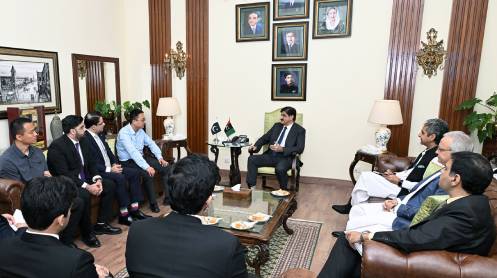
ISLAMABAD: The Special Investment Facilitation Council (SIFC) has initiated high-level engagements with a visiting Saudi delegation led by Chairman of the Pakistan-Saudi Joint Business Council, Prince Mansour, aimed at expanding investment cooperation across multiple sectors of Pakistan’s economy, according to well-informed sources in the Ministry of Energy.
The visit, scheduled from June 4–5, 2026, includes a series of government-to-government (G2G), government-to-business (G2B), and business-to-business (B2B) meetings focused on infrastructure, energy, agriculture, real estate, and logistics development.
Official documents indicate that the SIFC Secretariat has instructed relevant ministries and departments to prepare detailed project presentations and investment proposals to ensure “outcome-oriented discussions” with Saudi investors.
The engagement began on June 4 with an introductory meeting between leading Pakistani business figures and the Saudi delegation, which also included representatives of the Joint Business Council. Pakistan’s Ambassador to Saudi Arabia also participated in the discussions.
On the first day, multiple parallel sessions were held covering key infrastructure and logistics projects. These included deliberations on motorway developments such as M-6, M-10, and M-13, with participation from the Ministry of Communications and the National Highway Authority (NHA).
Separate discussions focused on expanding and upgrading Pakistan’s port infrastructure, involving senior officials from the Ministry of Maritime Affairs and representatives of the Karachi Port Trust (KPT), Port Qasim Authority (PQA), and Gwadar Port Authority (GPA), highlighting investment opportunities in port operations and development.
Another session explored aviation infrastructure, including airport development and operations, with participation from the Pakistan Airports Authority and relevant aviation stakeholders.
In the agriculture sector, investment opportunities in meat and rice processing were discussed with the Ministry of National Food Security, alongside participation from major institutional stakeholders, including the Fauji Foundation and affiliated entities.
On the second day, discussions are expected to focus on policy frameworks and investment roadmaps, including a proposed G2G and G2B model for executing development projects through joint Saudi-Pakistan public-private consortia involving both government-linked and private sector entities.
Energy cooperation will remain a central focus, with dedicated sessions on power and petroleum sectors. Power-related discussions will cover transmission infrastructure and smart metering systems, attended by senior officials from the Power Division along with Saudi counterparts.
Petroleum sector talks are expected to address gas metering, mining, and mineral development opportunities, with participation from the Ministry of Petroleum and Natural Resources.
Real estate, tourism, and urban development opportunities will also be reviewed, including hotel projects and property development initiatives involving the Ministry of Housing and Works, Capital Development Authority (CDA), Frontier Works Organization (FWO), and Defence Housing Authority (DHA).
The visit is expected to conclude with a B2B session of the Pakistan-Saudi Joint Business Council, where private sector representatives from both countries will explore potential partnerships, signaling a further deepening of bilateral economic cooperation.
Story by Mushtaq Ghumman